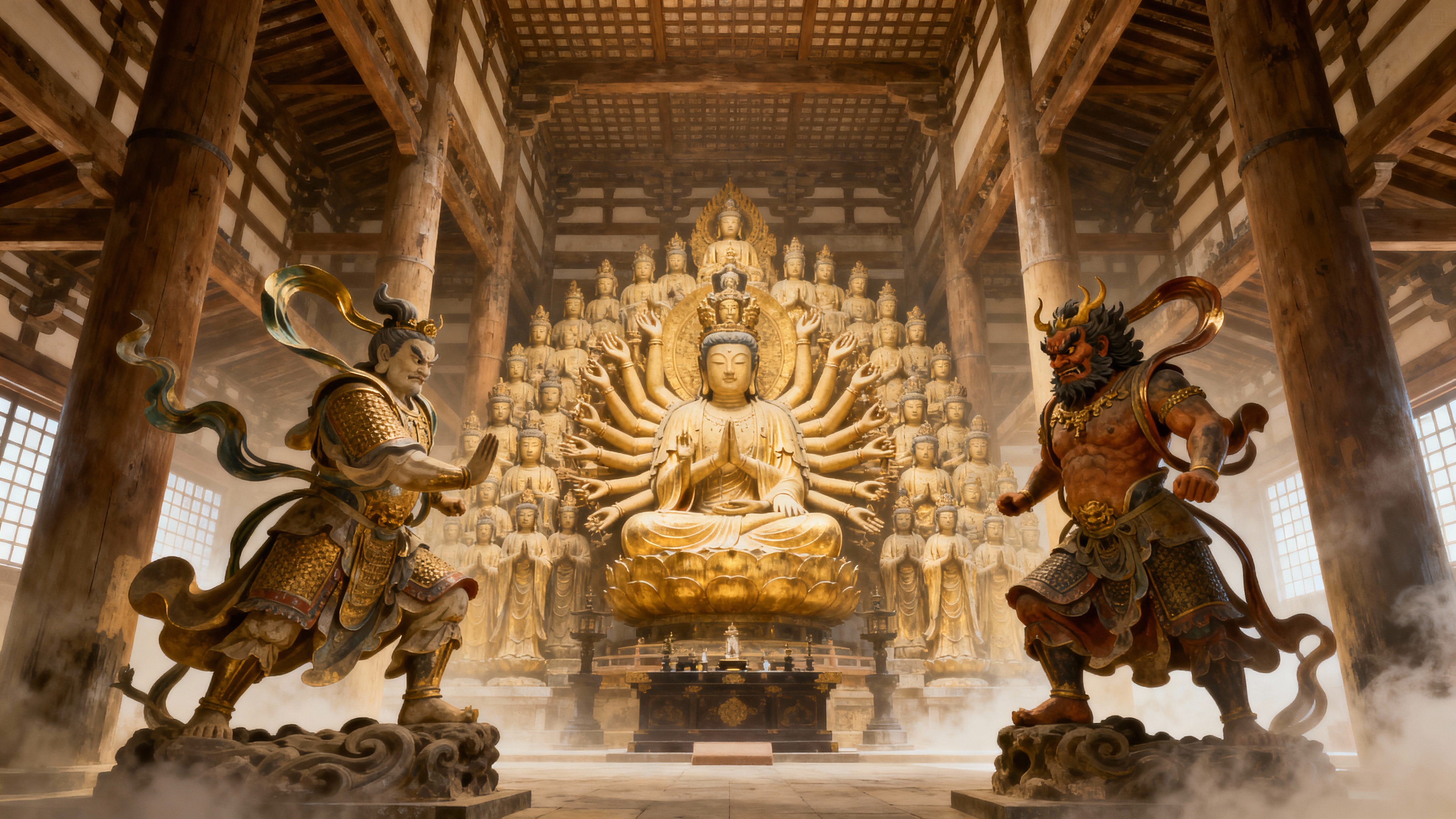
Enter the 120-meter hall of Sanjusangen-do and prepare for one of Buddhism’s most overwhelming spiritual encounters. Before you stretches an army of golden figures—1,001 statues of Thousand-Armed Kannon, each standing in silent vigil, their countless hands reaching out to offer salvation to all sentient beings. This isn’t merely an impressive collection of medieval art; it’s a sophisticated spiritual technology designed to overwhelm human consciousness with the infinite nature of Buddhist compassion.
The hall’s creators understood that some spiritual truths are too vast for ordinary perception and require extraordinary measures to comprehend. Why exactly 1,001 statues? What secrets do these golden figures hold about the nature of enlightenment and divine mercy?
The Sacred Mathematics of Infinite Compassion
The number 1,001 carries profound Buddhist significance:
- 1,000 represents completion and perfection in Buddhist numerology
- The additional “1” transcends perfection into the realm of the infinite
- Together, they symbolize compassion beyond human capacity to measure
The central seated Kannon, carved by master sculptor Tankei in 1254, anchors this spiritual constellation. Standing 3.3 meters tall, this National Treasure displays 42 principal arms—each capable of saving 25 worlds, totaling 1,000 manifestations of mercy, plus the central figure’s unified compassion.
The Artistic Marvel: 1,000 Unique Expressions of Mercy
Flanking the central figure, 1,000 standing Kannon statues create an overwhelming visual symphony. Each approximately 1.6 meters tall and carved from Japanese cypress, they appear identical at first glance. But closer inspection reveals the profound secret: no two faces are exactly alike.
Multiple sculptors of the Kei school worked over decades, each imparting subtle variations in:
- Facial expressions and features
- Hand positions and gestures
- Drapery folds and details
- Individual spiritual presence
This individuality within uniformity teaches that compassion manifests uniquely for each being’s specific needs while maintaining universal availability.
The Guardian Assembly: Protectors of Compassion
Twenty-eight Vajrapani attendants stand guard before the Kannon army, including fierce protective deities like Bishamonten and mythical creatures like Karura. At the hall’s extremes, the dynamic Wind God (Fūjin) and Thunder God (Raijin) add protective energy with their swirling forms and dramatic poses.
These guardians demonstrate that true compassion sometimes requires fierce protection of the innocent and active intervention against forces causing suffering.
Historical Genesis: From Imperial Vision to Spiritual Reality
Emperor Go-Shirakawa founded the temple in 1164 after experiencing prophetic dreams during severe headaches. Kannon appeared promising that 1,001 statues would cure his ailments and create healing for all beings. Though fire destroyed the original hall in 1249, the current structure (completed 1266) represents an even more ambitious realization of this divine vision.
The reconstruction occurred during the Kamakura period’s Buddhist renaissance, when Japanese Buddhism achieved unprecedented artistic and spiritual sophistication through:
- Advanced sculptural techniques enabling consistent yet individual statuary
- Sophisticated workshop organization coordinating dozens of master craftsmen
- Integrated spiritual design creating specific meditative experiences
- Community support reflecting Buddhism’s broad social appeal
The Spiritual Experience: Encountering Infinite Mercy
Visiting Sanjusangen-do requires preparation for an extraordinary spiritual encounter:
The Five-Stage Journey
1. Initial Overwhelm (5 minutes): Allow the hall’s full impact without analysis. Let the golden army wash over your consciousness.
2. Central Focus (10 minutes): Approach Tankei’s masterpiece. Notice the serene expression radiating active compassion and the multiple arms extending in blessing.
3. Individual Discovery (15-20 minutes): Walk slowly among the statues, letting intuition guide you to figures that resonate with your spiritual needs.
4. Guardian Contemplation (10 minutes): Observe the protective deities, considering how spiritual development requires both gentle mercy and fierce protection.
5. Integration (5-10 minutes): Position yourself to see the entire assembly, allowing the experience to settle into consciousness.
The Science of Overwhelming Beauty
Modern neuroscience validates the hall’s design principles. Research shows that exposure to overwhelming sacred art creates measurable changes promoting:
- Increased empathy and compassion-related brain activity
- Reduced stress hormones for up to 24 hours post-visit
- Enhanced emotional regulation and decreased negative reactivity
- Improved capacity for altruistic behavior
The “overview effect” experienced by astronauts seeing Earth from space creates similar neurological changes—a shift from self-centered to universal perspective promoting compassionate action.
Cultural Legacy: Influence Beyond Buddhism
Sanjusangen-do established precedents influencing Japanese culture for centuries:
Democratic Accessibility: Created a model for Buddhist spaces welcoming all social classes while maintaining sophisticated spiritual standards
Artistic Innovation: Demonstrated how overwhelming quantity could create qualitative spiritual transformation
Therapeutic Applications: Modern healing gardens worldwide incorporate similar principles of visual abundance and contemplative space
The Archery Connection: Toshiya Contests
Beyond spiritual significance, the hall hosted legendary archery contests during the Edo period. The Toshiya (通し矢) challenge required archers to shoot arrows the entire 120-meter length of the veranda—a test of skill and endurance still commemorated annually on the second Sunday of January.
Experiencing the Hall: Practical Guidance
Optimal Visiting Strategy
- Early morning (8:30-9:30 AM): Fewer crowds, better lighting, contemplative atmosphere
- Weekdays: Significantly less crowded than weekends
- Winter months: Most peaceful atmosphere with fewer tour groups
Respectful Engagement
- Photography prohibited inside: Commit visual details to memory
- Maintain quiet voices: Preserve contemplative atmosphere
- Move slowly and mindfully: Allow time for the statues’ spiritual presence to register
- Look for individual differences: Each Kannon offers unique spiritual qualities
Frequently Asked Questions
Q: Are all 1,001 statues original from the 13th century? A: The majority are original Kamakura period works, though some have been restored or replaced over the centuries using traditional techniques.
Q: Why “Thousand-Armed” if they only have 42 arms? A: The term is symbolic. Each of the 40 secondary arms (plus two main arms) represents 25 forms of salvation, totaling 1,000 manifestations of compassion.
Q: Can I meditate in the hall? A: Quiet contemplation is encouraged, but formal meditation practice should be arranged through the temple office.
Q: What’s the significance of the hall’s 33 bays? A: The 33 architectural divisions reference Kannon’s 33 different manifestation forms for saving sentient beings.
Planning Your Visit:
- Hours: 8:30 AM – 5:00 PM (Apr-Oct), 9:00 AM – 4:00 PM (Nov-Mar)
- Admission: ¥600 for adults
- Access: Keihan Main Line to Shichijo Station (7-minute walk)
- Allow: 1-2 hours for full contemplative experience
Continue Your Buddhist Journey: Explore “The Zen Philosophy of Ryoan-ji” for meditation insights, or discover “Why Zazen Calms the Mind” for practical spiritual practices.
Leave a Reply