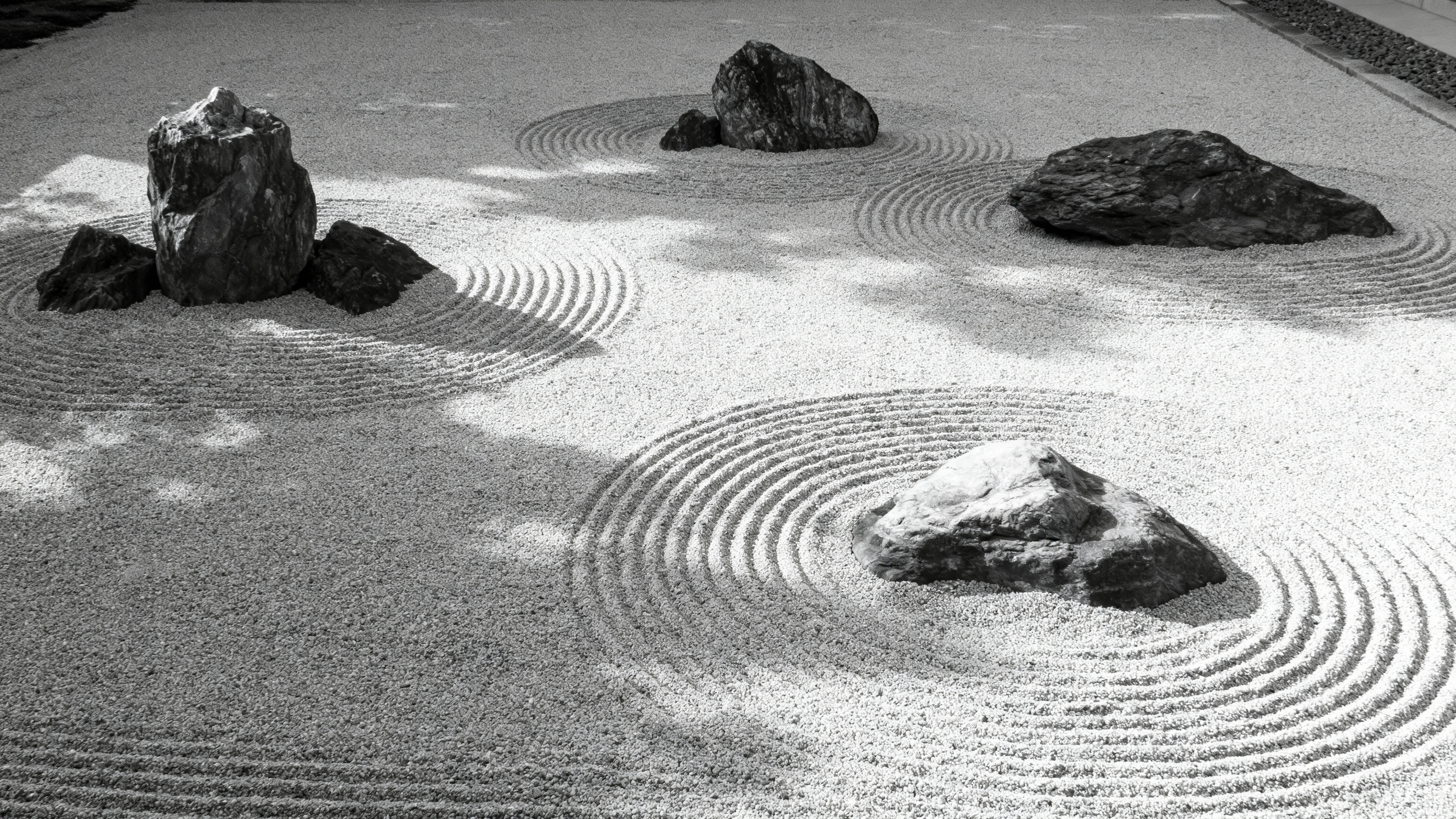
Standing before the most famous rock garden in the world, visitors to Ryoan-ji Temple encounter something that defies explanation: fifteen carefully placed stones on a bed of pristine white gravel, enclosed by humble clay walls. Yet no matter where you position yourself along the viewing veranda, you can never see all fifteen stones simultaneously. This isn’t an oversight—it’s the garden’s greatest teaching, embodying over 500 years of Zen wisdom about the nature of perception, enlightenment, and the beautiful incompleteness of human understanding.
The Sacred Mathematics of Imperfection
Why fifteen stones? In Buddhist numerology, fifteen represents completion—the full moon, the perfect circle of enlightenment. Yet the garden’s genius lies in making this completeness impossible to perceive from any single viewpoint. This deliberate “flaw” teaches us that absolute truth cannot be grasped through ordinary perception alone.
The stones are arranged in five asymmetrical groups across approximately 340 square meters of raked white gravel. Created in the late 15th century during the Muromachi period, this karesansui (dry landscape) garden strips away all decorative elements—no water, no plants, no flowers—leaving only the essential relationship between form (stones) and emptiness (gravel).
The Zen Teaching of Partial Vision
The invisible stone phenomenon illustrates core Zen principles:
1. Humility of Perspective: We experience reality from limited viewpoints. Just as one stone remains hidden, complete understanding often lies beyond our current perspective.
2. The Journey of Enlightenment: Traditional interpretation suggests the hidden stone becomes visible only upon achieving enlightenment—not through physical repositioning, but through transcending the need to “see everything.”
3. Active Participation: The viewer becomes the sixteenth element, completing the garden’s meaning through their own consciousness and contemplation.
Scientific Validation of Ancient Wisdom
Modern neuroscience validates what Zen masters understood centuries ago. Research shows that viewing the garden activates the brain’s default mode network—the same neural pathways engaged during meditation. The minimalist design reduces cognitive load, promoting what researchers call “soft fascination”—a state of relaxed attention that facilitates mental restoration and creative insight.
The garden’s “incomplete” visual field creates productive tension in the brain, engaging our pattern-completion instincts while preventing resolution, thereby maintaining a state of calm alertness ideal for contemplation.
Seasonal Transformations and Deeper Meanings
Each season reveals different aspects of the garden’s teaching:
- Spring: Soft shadows emphasize the three-dimensional relationships between stones
- Summer: Harsh light creates stark contrasts, demonstrating how truth appears different under varying conditions
- Autumn: Morning mist embodies mono no aware—the poignant awareness of impermanence
- Winter: Snow transforms the space into a study of white-on-white subtlety
How to Experience the Garden’s Teaching
Proper contemplation involves five stages:
- Initial Observation (5 minutes): Notice your immediate emotional response without analysis
- Detailed Study (10 minutes): Count the visible stones, observe gravel patterns, notice how shadows change
- Perspective Shifting (10 minutes): Move along the veranda, observing how relationships change
- Meditative Sitting (15-20 minutes): Choose one position for sustained, quiet observation
- Integration (5 minutes): Reflect on what has shifted in your perception
Frequently Asked Questions
Q: Is there really a 15th stone that can’t be seen? A: From any normal viewing position on the veranda, one stone remains hidden behind others. This is achieved through precise placement and the garden’s forced perspective design.
Q: What do the stones represent? A: While some interpret them as islands, mountain peaks, or tigers crossing a river, Zen philosophy encourages personal interpretation. The stones are simultaneously everything and nothing—form emerging from emptiness.
Q: Can I walk in the garden? A: No, visitors view the garden only from the veranda. This maintains the raked gravel patterns and preserves the intended perspective relationships.
Planning Your Visit:
- Hours: 8:00 AM – 5:00 PM (Mar-Nov), 8:30 AM – 4:30 PM (Dec-Feb)
- Admission: ¥600 for adults
- Best times: Early morning weekdays for contemplative atmosphere
- Access: Kyoto City Bus routes 59, 12, 50 to Ryoan-ji-mae
Continue Your Zen Journey: Explore our guide to “Why Zazen Calms the Mind” for meditation practices, or discover “Hidden Temple Gardens” for more contemplative spaces.
Leave a Reply