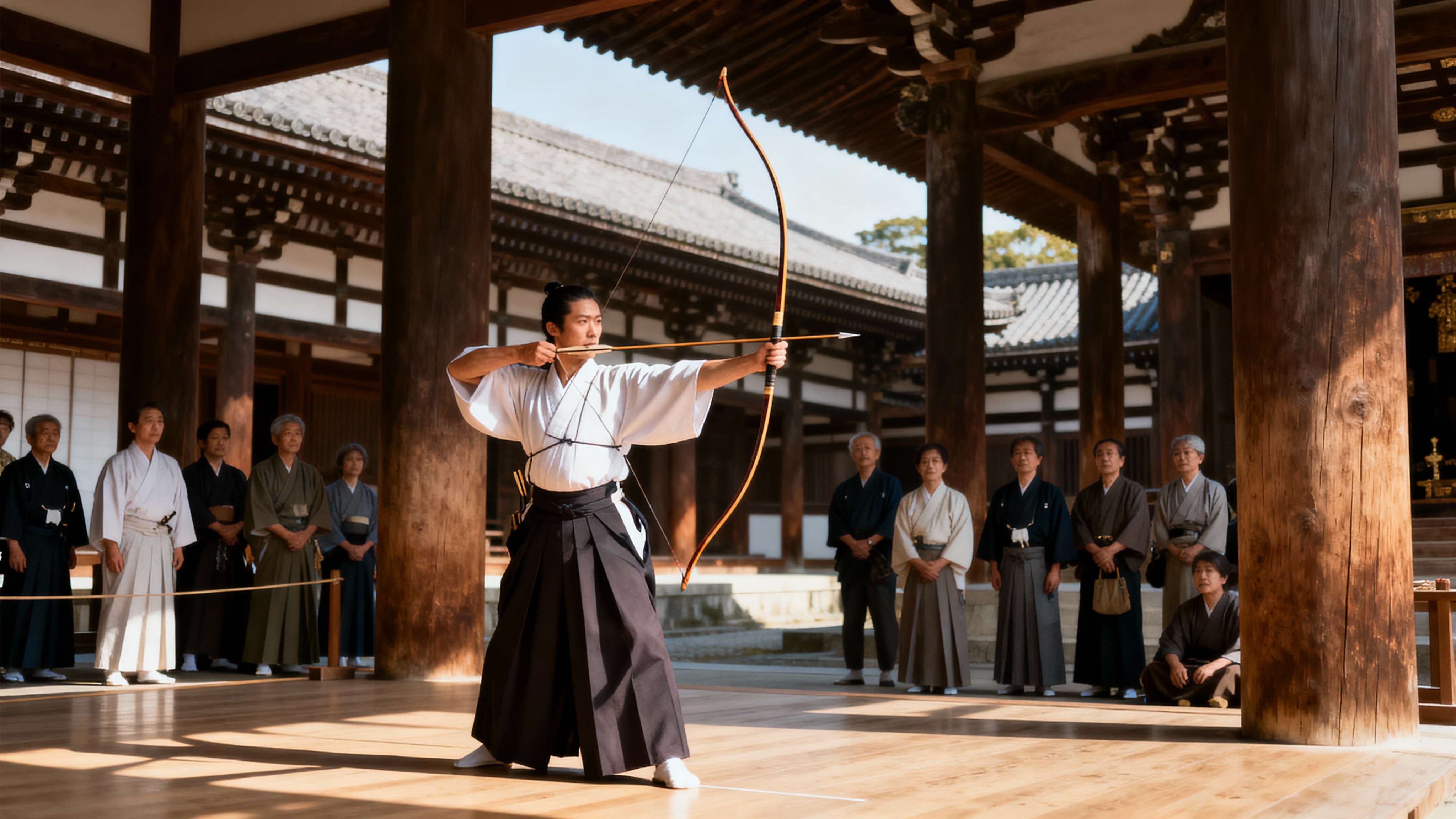
Imagine standing at one end of Sanjusangen-do’s 120-meter hall, surrounded by 1,001 golden statues of Kannon, preparing to shoot arrows the entire length of the building—not once, but potentially thousands of times over 24 consecutive hours. For over 400 years, this sacred Buddhist space witnessed one of Japan’s most extraordinary tests of human endurance and skill: the legendary Toshiya (通し矢) archery contests, where master archers pushed the boundaries of physical capability while maintaining spiritual composure under extreme pressure.
These competitions transformed a temple dedicated to infinite compassion into an arena of ultimate human achievement, creating legends that continue to inspire martial artists and spiritual seekers worldwide.
The Perfect Arena: Architecture Meets Challenge
Sanjusangen-do’s Unique Design
The temple’s architecture created ideal conditions for the ultimate archery test:
Precise Dimensions: The hall’s exact 120-meter length provided standardized distance for measuring skill and creating comparable records across centuries.
Covered Veranda: The western corridor’s roof allowed year-round competition regardless of weather, enabling consistent training and competition.
Narrow Passage: The restricted width demanded extraordinary accuracy—arrows had to travel straight without touching pillars, walls, or ceiling.
Sacred Witness: The 1,001 Kannon statues created spiritual audience, adding profound meaning to physical achievement.
The Ultimate Test: 24-Hour Endurance Challenges
Oyakazu: The Great Number Contest
The most legendary Toshiya competition involved continuous shooting for an entire day and night:
Physical Demands: Archers maintained shooting form and accuracy while fighting exhaustion, muscle fatigue, and mounting physical pain.
Mental Discipline: Success required extraordinary psychological endurance, maintaining focus despite sleep deprivation and intense pressure.
Technical Consistency: Every arrow had to travel the full distance without obstruction, demanding perfect technique sustained across thousands of attempts.
Spiritual Integration: The combination of physical challenge and sacred setting transformed archery into moving meditation.
Record-Breaking Achievements
Historical records preserve almost unbelievable individual performances:
Wasa Daihachiro (1686): Shot 13,053 arrows with 8,133 successful hits in 24 hours—over 62% accuracy maintained across an entire day.
Sustained Excellence: Top archers averaged one shot every 7-8 seconds for 24 hours straight, demonstrating superhuman endurance.
Technical Innovation: Competitors developed specialized equipment, shooting techniques, and support systems specifically for these extreme challenges.
Cultural Heroes: Successful Toshiya archers became legendary figures inspiring literature, art, and popular culture throughout Japan.
The Spiritual Dimension: Kyudo Philosophy
Archery as Zen Practice
Toshiya embodied the profound spiritual principles of kyudo (Japanese archery):
Mind-Body Unity: Success required perfect coordination between mental intention, physical technique, and spiritual composure.
Present-Moment Awareness: Each shot demanded complete focus on immediate technique while maintaining strategic awareness.
Breath Integration: Proper breathing was essential for accuracy and endurance, connecting physical and spiritual practice.
Ego Transcendence: The repetitive nature and extreme duration dissolved individual consciousness into pure action.
Buddhist Context
Competing within a Buddhist temple added layers of spiritual meaning:
Compassionate Witness: The Kannon statues represented infinite compassion observing human striving for perfection.
Merit Accumulation: Exceptional performance within sacred space was believed to generate spiritual benefit.
Meditation in Motion: The rhythmic shooting became form of walking meditation extending over 24 hours.
Community Blessing: Outstanding achievements were seen as bringing good fortune to the broader community.
Modern Legacy: From Contest to Cultural Tradition
The Annual Ōmato Ceremony
Contemporary Sanjusangen-do maintains connection to Toshiya traditions:
Coming-of-Age Celebration: Every January, young adults who recently turned 20 participate in ceremonial archery.
Cultural Education: The event demonstrates historical techniques while celebrating traditional values of discipline and perseverance.
Kimono Elegance: Participants dress in beautiful traditional clothing, creating spectacular visual display.
Community Gathering: The ceremony draws large crowds, maintaining social function of historical competitions.
Kyudo’s Continuing Influence
The spiritual principles developed through Toshiya continue in modern Japanese archery:
Character Development: Kyudo emphasizes personal growth through disciplined practice rather than competitive victory.
Meditation Practice: Modern practitioners use archery as form of moving meditation and stress relief.
Cultural Preservation: Kyudo schools maintain traditional techniques and philosophical approaches developed over centuries.
International Spread: The discipline has gained practitioners worldwide seeking both physical skill and spiritual development.
Experiencing the Legacy
Visiting During Ōmato Ceremony
The annual January event provides glimpse of Toshiya traditions:
Timing: Second Sunday of January, weather permitting Atmosphere: Festive yet respectful, celebrating both achievement and tradition Photography: Permitted but requires sensitivity to participants and sacred space Cultural Context: Understanding historical background enhances appreciation
Regular Temple Visits
Sanjusangen-do offers year-round opportunities to appreciate archery heritage:
Hall Contemplation: Walking the 120-meter length provides physical sense of the challenge archers faced.
Kannon Meditation: Contemplating the 1,001 statues connects visitors with the spiritual context of historical competitions.
Historical Imagination: The space naturally evokes the extraordinary human achievements witnessed within its walls.
Frequently Asked Questions
Q: Are the 24-hour Toshiya contests still held? A: No, the extreme endurance contests ended in the late Edo period, but ceremonial archery continues annually.
Q: How accurate were the historical records? A: Records were carefully maintained by temple officials and competing domains, though specific techniques may have differed from modern standards.
Q: Can visitors try archery at Sanjusangen-do? A: The temple doesn’t offer public archery experiences, but local kyudo schools provide instruction in traditional Japanese archery.
Q: What happened to the archery equipment and techniques? A: Many traditional methods are preserved in modern kyudo practice, though extreme endurance training is no longer emphasized.
Planning Your Archery Heritage Visit:
- Hours: 8:30 AM – 5:00 PM (April-October), 9:00 AM – 4:00 PM (November-March)
- Admission: ¥600 for adults
- Access: Keihan Main Line to Shichijo Station, 7-minute walk
- Special Event: Second Sunday in January for Ōmato ceremony
- Allow: 1-2 hours for contemplative visit to appreciate both Buddhist art and archery heritage
Continue Your Martial Arts Journey: Ready to explore more Japanese spiritual disciplines? Discover “The Birth of Wabi-Sabi at Ginkaku-ji” or learn about “The Garden Philosophy of Tenryu-ji.”
Leave a Reply