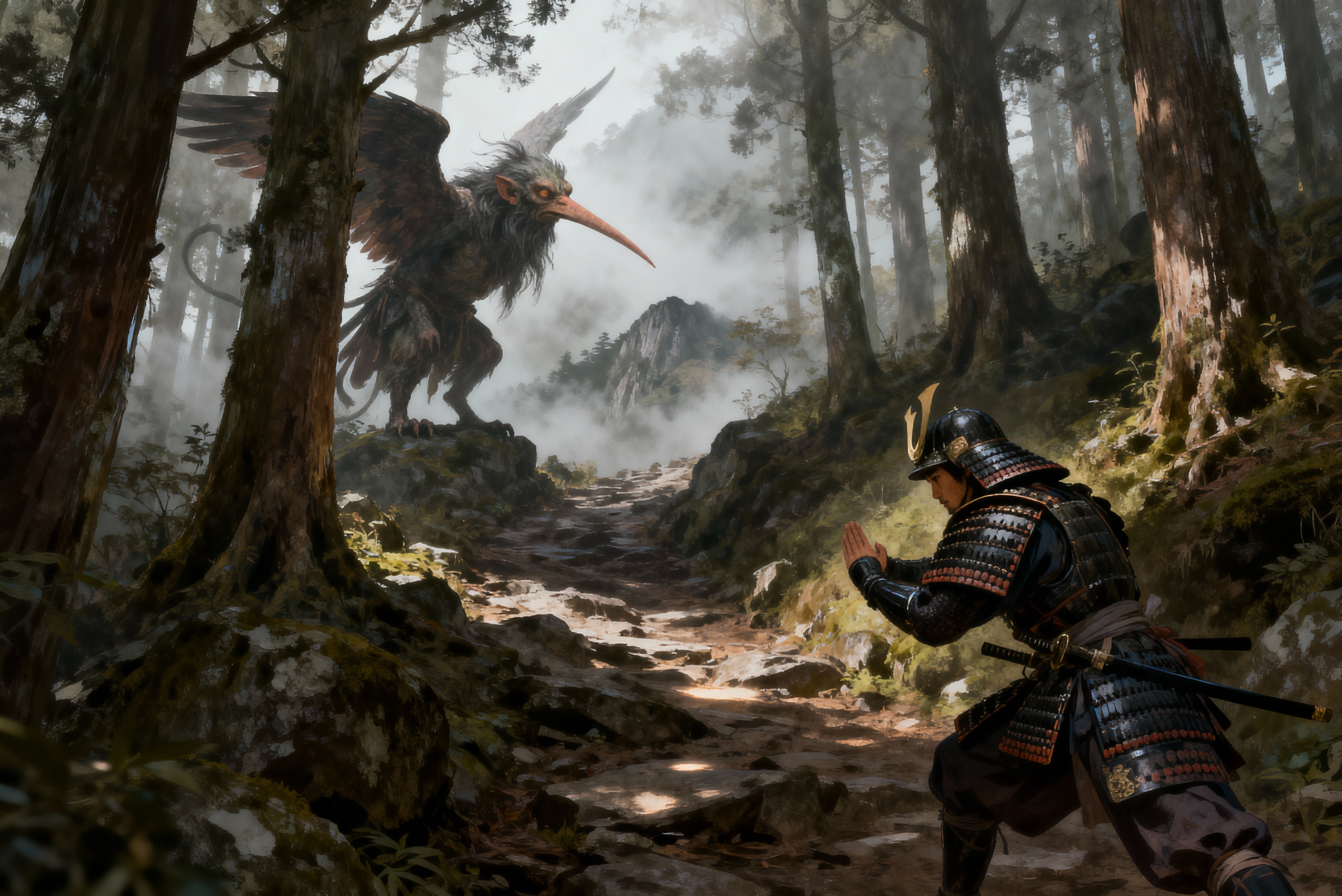
North of Kyoto, where urban sprawl yields to ancient forests and mist-shrouded peaks, lies Mount Kurama—a sacred mountain pulsing with supernatural energy. This mystical realm is legendary home to tengu (天狗)—powerful, long-nosed mountain spirits—and the secret training ground where Minamoto no Yoshitsune, Japan’s most celebrated warrior, learned the supernatural skills that made him invincible.
The mountain’s very atmosphere feels charged with ancient magic, where towering cedars cling to steep slopes and gnarled roots twist like serpents across forest floors. Here, the veil between human and spirit worlds grows thin, and a young exiled samurai learned abilities that would change Japan’s destiny forever.
Mount Kurama: Sacred Mountain of Spiritual Power
Kurama-dera Temple: Buddhist Foundation
Kurama-dera Temple, established in 770 AD, quickly became a center for unique syncretic Buddhism blending esoteric Buddhist practices with native mountain worship. The temple venerates Sonten (尊天)—cosmic energy embodying universal truth and power, manifested as:
- Bishamonten: Guardian deity of warriors and protectors
- Senju Kannon: Bodhisattva of infinite compassion
- Goho Sonjo: Protective deity maintaining cosmic order
The mountain’s dense forests, rugged terrain, and remote location naturally fostered legends of powerful, unseen beings dwelling in its sacred depths.
Geography of Supernatural Power
Mount Kurama’s unique characteristics created perfect conditions for supernatural encounters:
Spiritual Magnetism: The mountain’s mineral composition and magnetic properties create atmosphere sensitive individuals experience as spiritually charged
Ancient Sanctity: Indigenous Shinto traditions recognized the mountain as sacred long before Buddhist establishment
Natural Challenges: Steep terrain, dense forests, and harsh weather provide physical trials necessary for intensive spiritual and martial training
Strategic Location: Close enough to Kyoto for political relevance, remote enough for secret training and spiritual retreat
The Tengu: Masters of Mountain Wisdom
Understanding Tengu Phenomenon
Tengu are among Japan’s most complex supernatural beings—part human, part bird, part divine spirit. Unlike Western demons or angels, tengu embody both beneficial and dangerous supernatural power aspects, serving as teachers, tricksters, protectors, and challengers depending on circumstances and character of those encountering them.
Traditional tengu characteristics:
Physical Attributes: Human-like bodies with bird features—long noses or beaks, wings, talons, and incredible flight speed capability
Supernatural Abilities: Martial arts mastery, magic, shape-shifting, invisibility, and control over natural forces like wind and storm
Psychological Nature: Fierce pride, quick temper, but also deep wisdom and capacity for profound teaching when properly approached
Cultural Function: Guardians of sacred knowledge, particularly esoteric Buddhism and advanced martial arts techniques
Tengu Hierarchy and Spiritual Evolution
Japanese folklore describes different tengu types with varying power and wisdom levels:
Karasu-tengu (Crow Tengu): Lower-ranking tengu with bird-like features, associated with mischief and basic supernatural abilities
Yamabushi-tengu: Mountain ascetic tengu mastering esoteric Buddhist practices and serving as spiritual teachers
Dai-tengu (Great Tengu): Most powerful tengu lords ruling specific mountains and possessing near-divine wisdom and abilities
Sōjōbō: Legendary king of all tengu, residing on Mount Kurama and serving as ultimate martial arts master
Minamoto no Yoshitsune: The Destined Warrior
Historical Foundation: Ushiwakamaru’s Exile
Minamoto no Yoshitsune (1159-1189) began life as Ushiwakamaru, youngest son of Minamoto no Yoshitomo, powerful warrior clan leader. When Yoshitomo was killed in the Heiji Rebellion of 1159, infant Ushiwakamaru should have been executed with the defeated clan.
Instead, through political mercy and maternal protection, one-year-old Ushiwakamaru was sent to Kurama-dera Temple to be raised as monk—exile preserving his life while removing him from political relevance. This arrangement intended to ensure Minamoto bloodline would never again threaten the ruling Taira clan.
Psychological Profile of Future Legend
Ushiwakamaru’s childhood circumstances created perfect psychological conditions for extraordinary martial development:
Displaced Identity: Raised as monk but aware of warrior heritage, creating internal tension demanding resolution through action
Suppressed Destiny: Knowledge of greatness meant but confined to religious obscurity, generating intense motivation for self-development
Survival Necessity: Understanding life depended on developing capabilities exceeding normal human limitations
Spiritual Resources: Access to esoteric Buddhist practices developing mental discipline and supernatural sensitivity
Physical Challenges: Mountain monastery life demanding exceptional physical conditioning and mental toughness
The Legendary Training: How Tengu Create Warriors
Sōjōbō: The Great Tengu Master
According to detailed legend versions, Ushiwakamaru’s supernatural teacher was Sōjōbō (僧正坊), king of all tengu and greatest martial arts master in the supernatural realm. Sōjōbō recognized in the young exile potential for greatness serving both supernatural and human purposes.
Seven-Year Supernatural Development Curriculum
Traditional accounts describe training lasting seven years (ages 7-14):
Years 1-2: Foundation Building
- Basic physical conditioning using supernatural methods
- Introduction to tengu flight and movement techniques
- Elementary sword work with supernatural precision
- Meditation practices developing supernatural sensitivity
Years 3-4: Advanced Techniques
- Combat applications of supernatural speed and strength
- Weapons mastery including sword, bow, and spear
- Strategy and tactics for individual and mass combat
- Development of supernatural perception abilities
Years 5-6: Integration and Mastery
- Combining supernatural abilities with conventional martial arts
- Leadership training and warrior psychology understanding
- Advanced strategic thinking and battlefield awareness
- Moral and ethical development for responsible power use
Year 7: Final Testing and Graduation
- Comprehensive challenges testing all developed abilities
- Real-world application of supernatural martial skills
- Preparation for return to human society and political involvement
- Formal recognition as supernatural martial arts master
Secret Techniques: What Tengu Actually Taught
Historical analysis of Yoshitsune’s actual martial abilities suggests techniques exceeding normal human capacity:
Superhuman Speed: Historical accounts describe movement faster than opponents could track, suggesting supernatural enhancement or extremely advanced training
Uncanny Anticipation: Ability to predict enemy actions and counter before full execution implies supernatural perception or extraordinarily developed tactical intuition
Impossible Leaps: Descriptions of incredible distance and height leaps suggest supernatural flight abilities or advanced human potential maximization techniques
Strategic Genius: Military innovations and tactical brilliance exceeded normal education provision, implying advanced knowledge source access
Psychological Mastery: Ability to inspire loyalty and fear equally suggests human psychology understanding transcending ordinary experience
Historical Impact: Legend Becomes Reality
Genpei War: Supernatural Training Meets Historical Necessity
When Ushiwakamaru emerged from Mount Kurama as adult Yoshitsune, he immediately demonstrated martial abilities seemingly validating supernatural training legends. His role in the Genpei War (1180-1185) showcased techniques appearing to exceed normal human capability.
Key battles demonstrating supernatural-level abilities:
Battle of Kurikara (1183): Tactical innovations including night attacks and terrain manipulation suggesting supernatural battlefield awareness
Battle of Yashima (1185): Famous ship-to-ship leaps during naval combat appearing to demonstrate supernatural movement abilities
Battle of Dan-no-ura (1185): Final Taira defeat involving strategic decisions seeming to demonstrate supernatural insight into enemy psychology
Tragic Irony: Supernatural Power vs. Political Reality
Despite supernatural martial abilities, Yoshitsune’s story ended tragically—betrayed by brother Minamoto no Yoritomo and forced to commit suicide in 1189. This outcome reveals crucial supernatural training limitation: it can develop extraordinary individual abilities but cannot overcome fundamental human nature and political reality challenges.
Modern Kurama: Experiencing the Legend
Sacred Sites and Legendary Locations
Mount Kurama bears marks of Yoshitsune’s legendary training:
Kinone Michi (木の根道 – Tree Root Path): Trail section where massive tree roots create challenging, uneven path. Legend says Yoshitsune trained here, leaping over roots to develop agility
Tengu no Negi (天狗の寝木 – Tengu’s Sleeping Tree): Massive ancient cedar where Sōjōbō supposedly rested
Yoshitsune Hall: Small shrine dedicated to young Yoshitsune’s memory
Training Stones: Various rocks throughout the mountain associated with specific training exercises
The Kurama to Kibune Hike
The scenic mountain trail from Kurama-dera to Kibune Shrine offers immersive experience blending natural beauty with ancient mystique:
Duration: 2-3 hours depending on pace and exploration stops Difficulty: Moderate, with some steep sections and root-covered paths Highlights: Dense cedar forests, mountain streams, panoramic views, and legendary training sites
Cultural Significance: Intersection of Worlds
Supernatural Mentorship Theme
Yoshitsune’s tengu training represents recurring Japanese mythology theme of receiving instruction from non-human entities, reflecting belief in worlds beyond human perception and supernatural assistance availability for those prepared to receive it.
Martial Arts and Spirituality Connection
The legend emphasizes deep Japanese warrior culture connection between martial prowess and spiritual discipline, understanding that highest combat mastery requires not just physical skill but spiritual development and moral character.
Experiencing Mount Kurama Today
Pilgrimage Preparation
Approaching Mount Kurama with proper understanding enhances the spiritual and cultural experience:
Physical Preparation: Mountain hiking requires appropriate footwear, water, and physical conditioning
Cultural Sensitivity: Remember this remains active religious site where spiritual practices continue
Open Mindedness: Whether literal or metaphorical, tengu legends contain profound truths about human potential and spiritual development
Optimal Visiting Strategy
Early morning weekday visits provide most contemplative atmosphere for experiencing mountain’s mystical qualities. Autumn and spring offer ideal weather conditions, while winter snow creates ethereal beauty requiring more careful navigation.
Frequently Asked Questions
Q: Are tengu real supernatural beings? A: Tengu exist in Japanese folklore and spiritual tradition rather than as physical entities. However, their legends convey profound truths about human potential, spiritual development, and relationship with natural forces.
Q: Can visitors see evidence of Yoshitsune’s training? A: While physical evidence is legendary rather than historical, the mountain’s challenging terrain and spiritual atmosphere provide insight into conditions that might produce extraordinary human development.
Q: How long does the Kurama to Kibune hike take? A: Most hikers complete the trail in 2-3 hours, though allowing extra time for exploration and contemplation enhances the experience.
Q: Is Mount Kurama suitable for children? A: The hike requires moderate physical ability and sure footing on uneven terrain. Children should be accompanied by adults and have appropriate hiking experience.
Q: What’s the best season to visit? A: Spring and autumn offer ideal weather and beautiful foliage. Summer can be humid but provides lush forest experience. Winter offers serene beauty but requires careful navigation.
Planning Your Visit:
- Hours: Kurama-dera Temple 9:00 AM – 4:30 PM; mountain trail accessible longer
- Admission: ¥500 temple entrance fee (includes trail maintenance)
- Access: Eizan Railway from Demachiyanagi to Kurama Station
- Allow: Half-day for temple and short hikes, full day for complete Kurama-Kibune trail
- Best Times: Early morning for tranquil experience
Continue Your Mythical Journey: Explore “The Sacred Foxes of Fushimi Inari” for more supernatural beings, or discover “Mount Hiei’s Spiritual Fortress” for additional sacred mountain experiences.
Leave a Reply