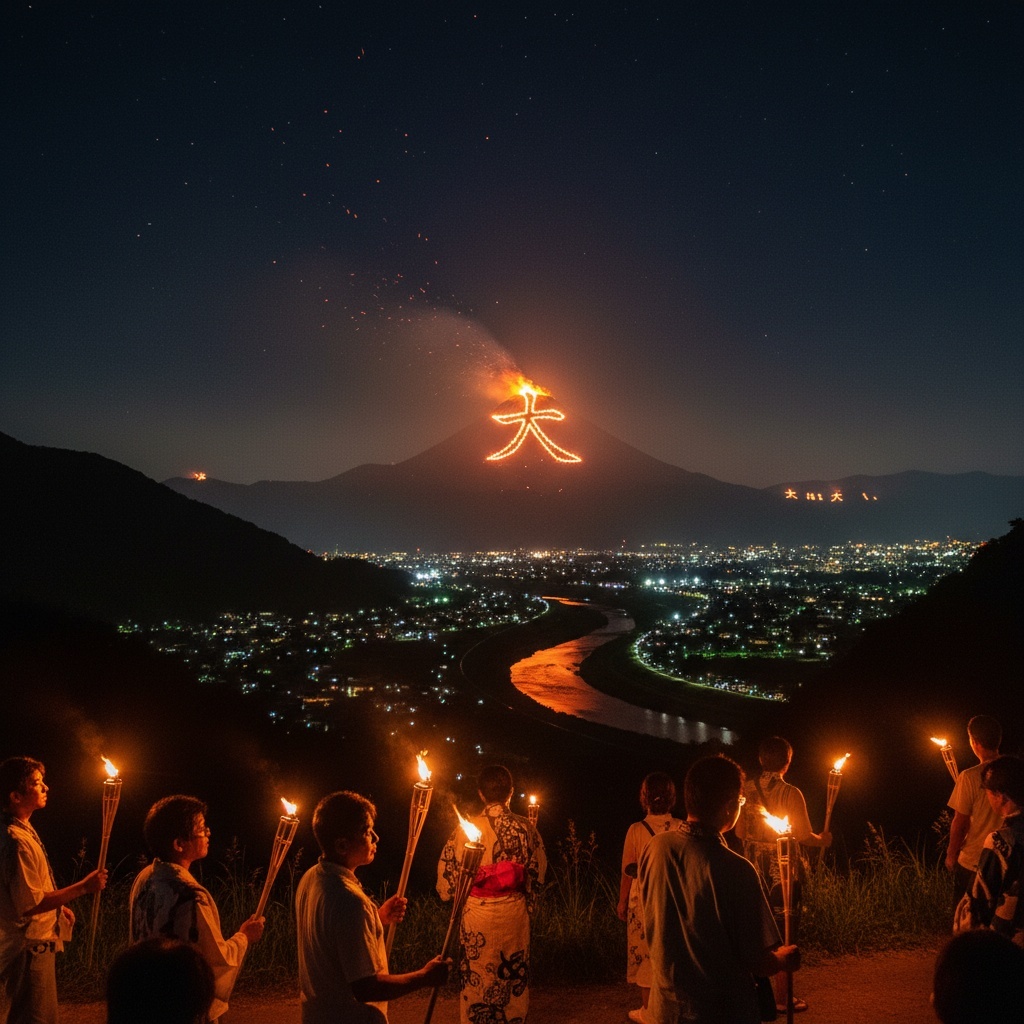
As darkness falls over Kyoto on August 16th, five sacred fires ignite on surrounding mountain peaks in perfect sequence, creating a spectacular ring of flame that has guided ancestor spirits home for over 500 years. Gozan Okuribi (五山送り火), the “Five Mountain Send-off Fires,” represents one of Japan’s most profound spiritual spectacles—a Buddhist ritual where earthly fire becomes celestial beacon, where community devotion transforms mountainsides into altars, and where the boundary between living and dead dissolves in sacred flame.
This is not mere fireworks or festival entertainment; it’s deeply sacred technology for spiritual communication, where thousands of individual prayers written on wood feed flames that carry messages between worlds, creating a bridge of fire connecting Kyoto’s living community with the realm of ancestral spirits.
The Sacred Geometry: Five Mountains, Five Meanings
Understanding the Spiritual Landscape
Each fire carries specific Buddhist significance:
Daimonji (大文字) – 8:00 PM: The great character “dai” (大) on Mount Nyoigatake represents Buddhist compassion’s vastness and Buddha’s great teaching.
Myoho (妙法) – 8:05 PM: Two fires on Mount Matsugasaki form “myo” (妙) and “ho” (法), representing the Lotus Sutra’s wonderful dharma.
Funagata (舟形) – 8:10 PM: The boat shape on Mount Nishigamo represents the spiritual vessel carrying souls across death’s river to enlightenment.
Hidari Daimonji (左大文字) – 8:15 PM: Second “dai” character balances spiritual energy across Kyoto’s landscape.
Toriigata (鳥居形) – 8:20 PM: Shinto shrine gate on Mount Mandara represents Buddhist-Shinto integration in Japanese spiritual life.
Optimal Viewing Strategies and Cultural Respect
Best Viewing Locations with Spiritual Context
Kamo River Banks: Traditional viewing area providing clear sightlines to multiple fires while maintaining appropriate reverence for ceremony’s sacred nature.
Kyoto Imperial Palace Park: Spacious grounds offer unobstructed views with historical context reinforcing cultural significance.
Yoshida-yama Park: Elevated position near one fire location creates intimate connection while viewing distant flames.
Cultural Etiquette for Sacred Viewing
Respectful Observation Guidelines:
- Quiet Reverence: Maintain contemplative atmosphere appropriate for spiritual ceremony
- Early Arrival: Secure viewing positions 2-3 hours before lighting while respecting local customs
- Photography Respect: Focus on personal spiritual experience over documentation
- Community Awareness: Share space considerately with local families observing ancestral connections
Frequently Asked Questions
Q: What happens if it rains on August 16th? A: The fires proceed regardless of weather conditions, as spiritual necessity transcends comfort. Rain may enhance mystical atmosphere.
Q: Can I write prayer sticks even if I’m not Buddhist? A: Many temples welcome respectful participation from all backgrounds with sincere intention and cultural sensitivity.
Q: How long do the fires burn? A: Each fire burns approximately 30-45 minutes, with complete sequence lasting about one hour from first lighting to final embers.
Leave a Reply